What if lettuce could be grown by integrating nutrients recovered from livestock waste into fertilisation strategies? Within the Interreg North-West Europe Programme, the BIOBOOST-PRO project explores how bioponics can turn manure into a valuable resource for more sustainable food production.
Scale up of the test system
After successfully completing a first screening trial using manure‑based fertilisers in lettuce production, Inagro took the next step in further exploring bioponic strategies for leafy greens. Building on the promising initial results, a new trial was launched at Inagro, with a clear focus on both nutrient recipe optimisation and practical scalability.
In this latest trial, different fertiliser recipes were tested but the experimental setup was also scaled up. Moving from small, closed-loop systems to a central system that better mimics a real-world production conditions. This approach allowed to evaluate not only plant performance, but also whether the use of alternative fertilisers could cause issues in pumps, pipes, or other system components. Testing technical robustness is essential before such strategies can be applied in practice.
Testing new products
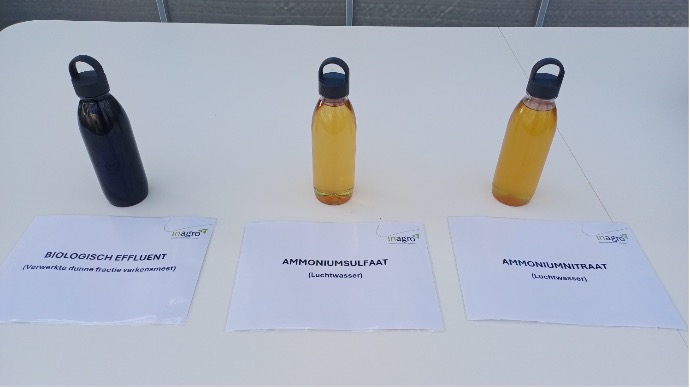
As in the previous experiment, we included a mineral fertiliser solution as a control treatment. This time, however, we explored a new manure‑derived fertiliser: ammonium nitrate, a product comparable to ammoniumsulphate. Both products are ammonium salts that can potentially be recovered from air scrubbers in large livestock production. They arerelatively pure in composition, though they differ inthe nutrients they supply. Ammonium sulphate provides nitrogen and sulphur, while ammonium nitrate supplies both ammonium and nitrate nitrogen.
Ammonium nitrate is particularly interesting for plant , as nitrate is a key element in most recipes. Having both nitrogen forms available in a single could simplify strategies. In addition to using ammonium nitrate alone, we also tested a combination with processing effluent, similar to the setup in the previous trial, to assess whether these blends could further enhance results
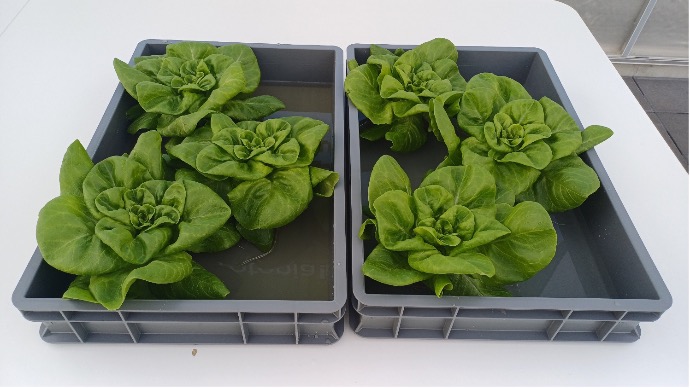
Overall, the trial ran very smoothly. The application caused no technical issues, no problems with clogging, pump malfunction, or system instability, demonstrating that thesecan be safely applied in a central system at a larger scale.
The results were highly encouraging. Average lettuce head weights reached around 400 grams, which is considered standard, and quality was comparable to that of the control treatment. In total, close to 2,000 lettuce crops were produced during the trial. By working at this scale, we were able to demonstrate that upscaling systems using ‑derived is feasible and that lettuce can grow very successfully on these alternative sources.
This work confirms that, with carefully balanced recipes and attention to system management, ‑based can play a meaningful role in lettuce . The results strongly support further development and practical implementation of these strategies.