Europe’s greenhouse production depends largely on imported mineral fertilisers, while nutrients from livestock manure are often lost at regional level.
BIOBOOST-PRO investigates how bioponics can help close this gap. In a first lettuce trial, partner Inagro tested circular fertilisers derived from pig manure in a hydroponic system. The results show that partial substitution is possible without compromising yield or quality.
This work contributes to a broader transnational effort across North-West Europe to test and optimise bioponic systems in real-life conditions. Through on-site and off-site pilot demonstrations, the project generates technical, economic and environmental data to support the transition from mineral to circular fertilisation. These findings will inform the development of business models, a territorial strategy methodology and a practical toolkit for growers, manure suppliers and policymakers.
Why the choice for circular fertilisers?
Greenhouse systems rely heavily on imported synthetic minerals to ensure crops recieve sufficient plant nutrients. Meanwhile livestock farming can produce large volumes of nutrient‑rich residuals that are often underutilized in farming systems due to sanctioned limitations. Circular fertilisers can closely resemble their mineral counterparts in their nutrient profile while often containing minimal contaminants. They provide essential plant nutrients but can also contain less desirable components like ammonium and chlorides, which can limit integration in certain fertigation schedules. Circular fertilisers have already proven successful in open‑field vegetable production, which inspired us to test their potential in greenhouse hydroponics.
Bioponics with circular fertilisers derived from pig manure
At Inagro we investigated the possibilities of an off-site system using pig manure derived products. An off-site pilot means that manure streams are processed at an external facility, preferably located close to the greenhouse. The processed stream, a circular fertiliser, is collected and transported to the greenhouse. This is different from on‑site systems where livestock and processing are integrated.
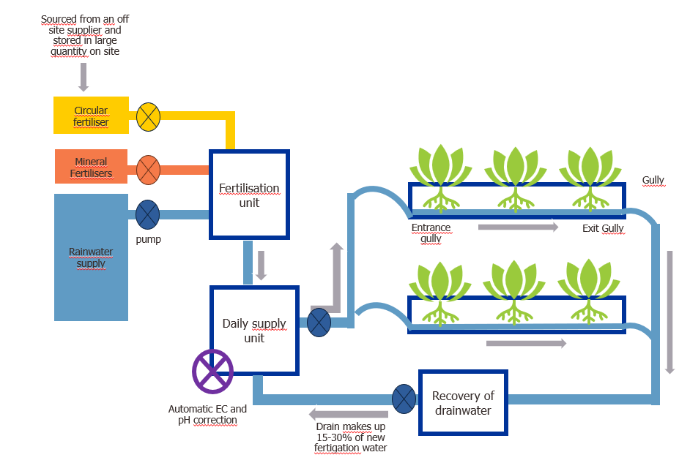
The goal of this off-site bioponics trial was to evaluate whether circular fertilisers from pig manure processing can partially substitute mineral fertilisers in a mobile gutter cultivation of butterhead lettuce. This is a first trial to take small steps towards a working bioponics system.
We tested three circular nutrient recipes:
- Manure processing effluent: a potassium‑rich effluent originating from pig manure;
- Ammonium sulphate from an ammonia stripping installation, that is rich in sulphates and ammonium;
- As well as a combination of both circular fertilisers to utilizing all nutrients available in both streams to increase the share of circular fertilisers in the recipe as much as possible.
All circular fertiliser treatments were tested against a mineral control. Each treatment ran on replicated, fully recirculating mobile gutter units with the same EC, pH and nutrient targets for the recipe.
Similar crop yields and crop quality
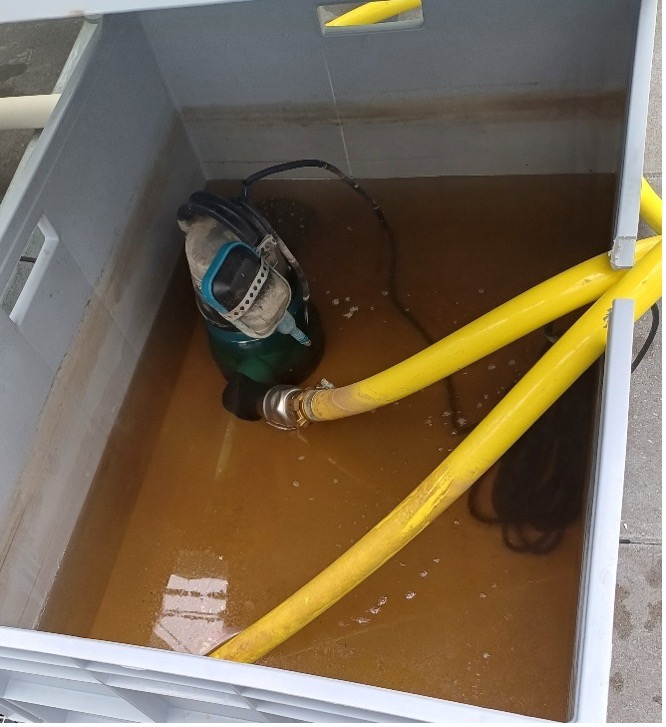
For growers, their key priority is maintaining production levels and ensuring that crop quality does not decline when switching over to a bioponics system. As this directly impacts the value of their produce and income. Across the different treatments, crop yields achieved with circular fertilisers were comparable to those of the control plants. The only exception was the treatment using solely ammonium sulfate, which showed a decrease in yield, likely due to a lower sulphate concentration in the recipe caused by lower contents of ammonium in the circular fertilisers than expected.
Similar trends were observed for quality parameters and root development across treatments. Root assessments revealed no consistent increase in blackened tips or discoloring in the circular fertiliser treatments. On the contrary roots exhibited more extensive growth when treated with manure processing effluent, suggesting a potential biological benefit or the presence of trace elements that have yet to be further identified.
These findings highlight the importance of accurate analysis of the nutrient stream/circular fertiliser to ensure proper usage. This will be an essential step when trying to achieve the most economic and practical value when using circular fertilisers.
Food safety and contamination checks
Because these nutrients originate from manure processing, we looked in particular into possible microbiological contamination of the product. As this can pose bottlenecks for the application in some legal frameworks. We analysed the pure circular fertilisers as well as the harvested product (lettuce heads and roots) for the presence of fecal contaminants like E. coli and Enterococci.
The pure circular fertilisers contained varying levels of faecal contaminants depending on the processing of the stream. However no faecal indicators were detected in the edible product (heads) across all treatments (results at or below the detection limit used). This outcome, in a fully recirculating NFT context, is an important first data point suggesting that properly processed and quality‑controlled circular streams can be integrated without risk of faecal contamination in or on the crops.
Future research
Future trials will focus on:
- Recipe optimisation, including testing other pig manure derivatives
- Working on the ammonium limitation in the recipe, either through nitrification of manure streams or by determining the maximum safe ammonium level in crop recipes
- Economic and energy evaluation of replacing mineral fertilisers with circular ones, including investment costs and barriers
These first results show that circular fertilisers derived from pig manure can be integrated into hydroponic systems without compromising crop performance, provided that nutrient composition is carefully managed.
Beyond the agronomic outcomes, the trial underlines the importance of reliable nutrient analysis, regulatory clarity and economic feasibility when moving towards circular fertilisation.
By generating practical data under real-life conditions, BIOBOOST-PRO contributes to a structured pathway for growers, manure processors and policymakers to make informed decisions and advance the transition from a linear fertilisation model to a more circular and resource-efficient agricultural system in North-West Europe.