The objective is clear: to transform nutrients from poultry manure into a liquid solution that can be effectively used by plants in soilless cultivation, while preserving the biological processes that keep these systems functional.
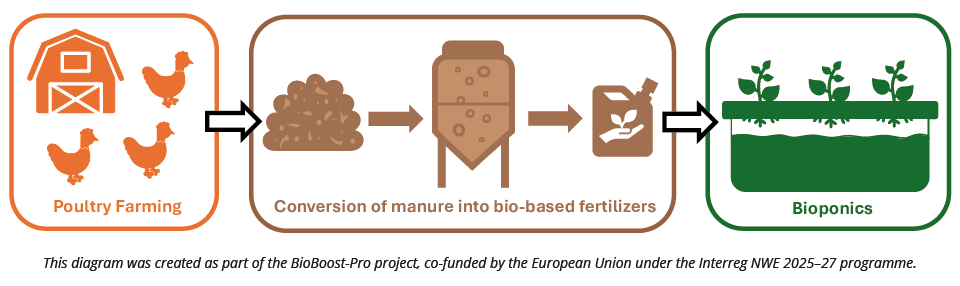
First step : Mineralisation of organic matter
The process, summarised in the schematic overview, begins with a seven-day maceration phase. This step aims at promoting the mineralisation of organic matter, therefore converting the nutrients contained in the manure into mineral forms present in the aqueous phase.
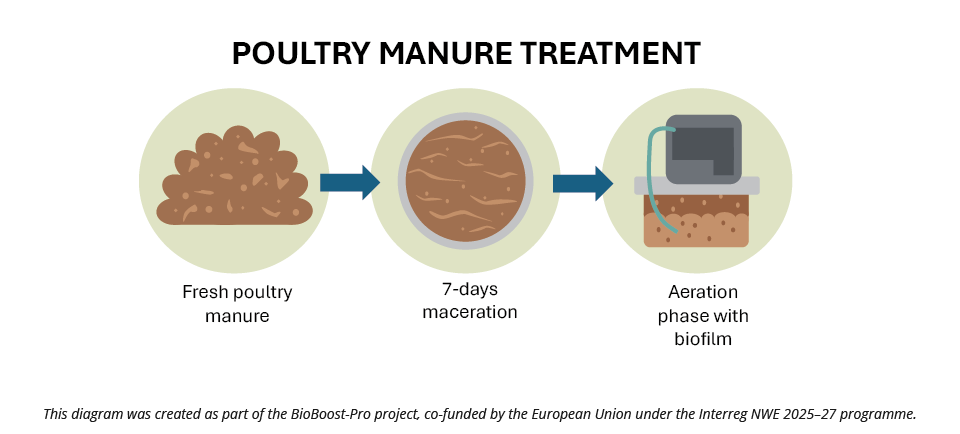
Three concentrations are tested: 10 percent, 15 percent and 20 percent of manure per volume of water.
Key result: the feasibility of the process is confirmed.
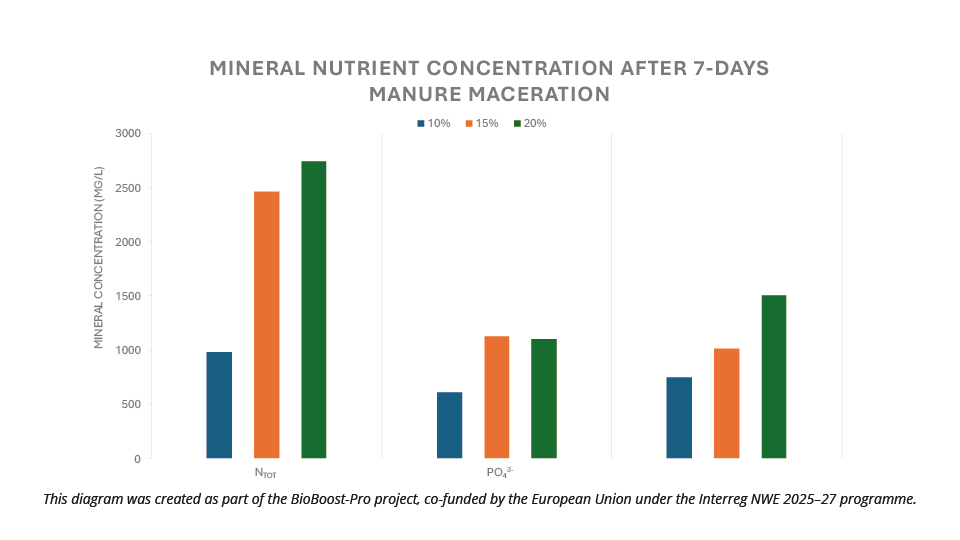
The resulting solution shows significant concentrations of mineralised nutrients:
- Total mineral nitrogen: 1 000 to 2 700 mg per L
- Orthophosphates: 600 to 1 100 mg per L
- Potassium: 750 to 1 500 mg per L
These results confirm the potential of poultry manure as a nutrient source for soilless cultivation systems.
The diagram below illustrates the mineral nutrient concentrations measured after the seven-day manure maceration phase:
A critical point : The form of nitrogen
The analysis nevertheless reveals a major constraint: more than 99 percent of the nitrogen present is in ammoniacal form.
In hydroponic and bioponic systems, this form of nitrogen can become problematic at high concentrations Ideally, the level of ammonium should be kept below 20%.
The preferred form for plant uptake remains nitrate, which is more stable and better tolerated.
The challenge is therefore not only to mobilise nutrients, but to transform their chemical form to make them compatible with soilless cultivation.
Nitrification : a key process for bioponics
The next phase focuses on a central process in bioponics: nitrification, that is, the conversion of ammonium into nitrates.
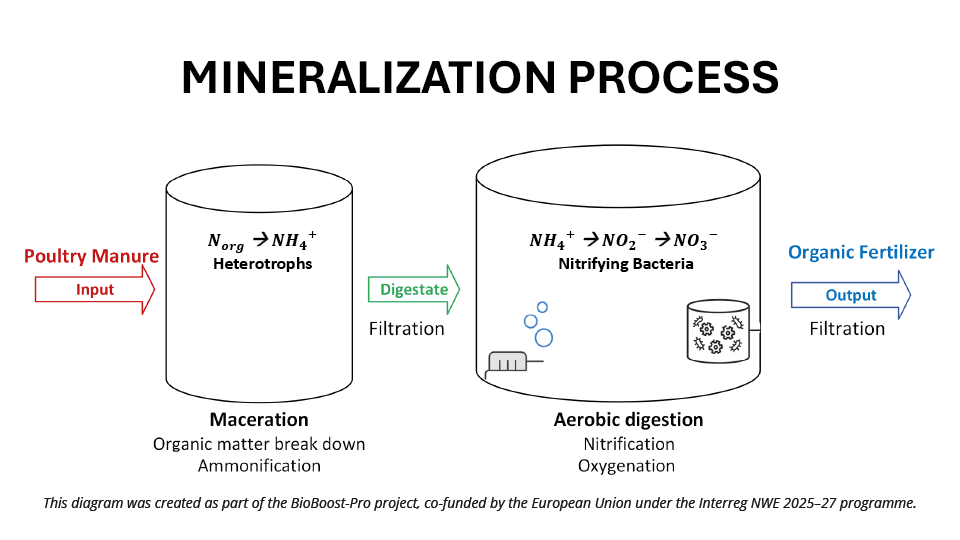
This transformation relies on the activity of nitrifying bacteria, which require:
- high oxygenation,
- stable physicochemical conditions,
- a medium with a viscosity compatible with their biological activity.
The nutrient richness and viscosity of the manure based digestate represent a significant technical challenge at this stage.
Technical approaches currently under study
To promote nitrification while maintaining the fertilising value of the solution, several approaches are being tested:
- mechanical filtration,
- chemical flocculation,
- different aeration systems, including diffusers and cascade systems,
- adjustments of dilution levels.
These trials aim to identify the most favourable conditions for effective nitrification in bioponics, without compromising the overall system balance.
Next step: agronomic trials under real conditions
Once the ammonium to nitrate conversion is optimised, the bio-based liquid fertilizer will be tested in agronomic trials on lettuce.
Its performance will be compared with that of a standard mineral fertilizer, with trials planned to start in January.
These first trials illustrate the concrete challenges of bioponics: adapting nutrients derived from organic residues to the biological constraints of soilless cultivation.
Through BIOBOOST PRO, this work contributes, in a progressive and rigorous way, to documenting the conditions required for the development of truly circular bioponic systems based on experimental and reproducible data.