This study takes a further step toward connecting mathematical models with real production data. Researchers developed a mechanistic dynamic model based on the ASTREDHOR pilot facility in France, integrating hydraulic transport, biological processes, nutrient transformations and plant uptake within a common computational framework.
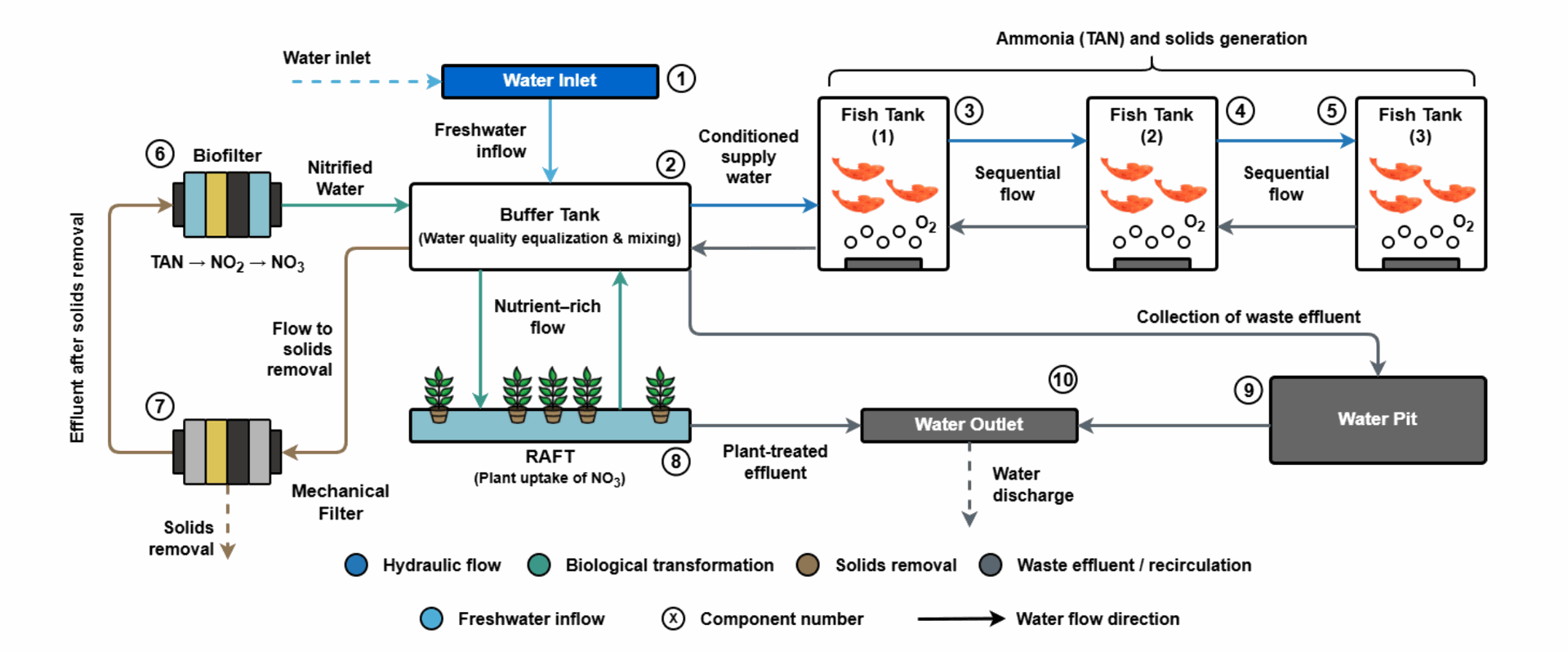
The ASTREDHOR aquaponic system represented in the model, showing fish tanks, filtration units and plant cultivation. Source: Korkut & Rachid (2026), Figure 1, AgriEngineering. Original article. CC BY.
The fish-growth component was assessed using biomass trajectories reconstructed from periodic fish measurements across three production cycles. Sensitivity analysis explored which parameters most influenced the simulations. Water-quality and plant-uptake outputs were not independently validated because complete measurement time series were unavailable. Scenarios involving feeding and biofilter sizing therefore remain exploratory and require further confirmation.
Rather than claiming a complete digital twin, the current framework is described as an off-line digital shadow: a model connected to information from the physical system but not yet continuously synchronised with it in real time. Within BIOBOOST-PRO, this represents a practical step toward using process-based models for scenario testing, system design, performance assessment and decision support, while preparing the ground for future real-time digital-twin applications.
Read the Scientific article